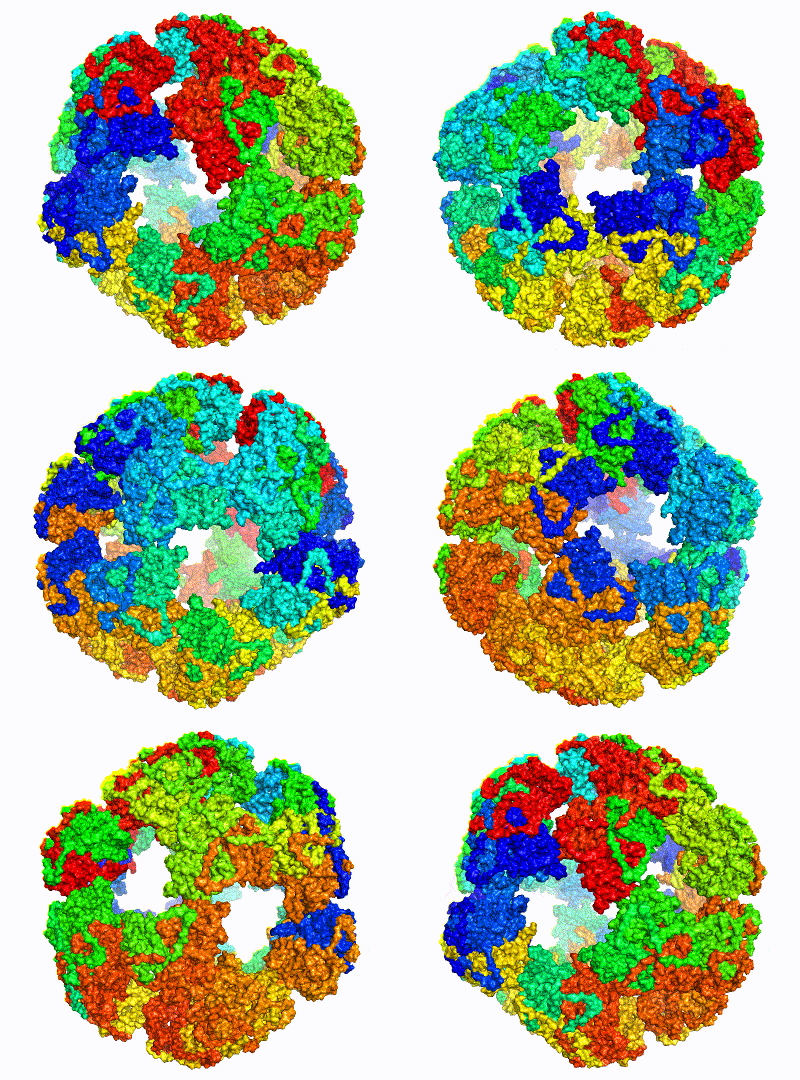
Protein cages are nanoscale particles formed by self-assembling protein subunits, with natural roles spanning storage (ferritin), protection (heat shock protei…Protein cages are nanoscale particles formed by self-assembling protein subunits, with natural roles spanning storage (ferritin), protection (heat shock proteins), catalysis, and genetic material transfer (viruses). Through nanotechnology, they have been repurposed for vaccine scaffolds, drug delivery, imaging, and molecular electronics, making them central to nanobiotechnology.
We are developing fast forecasting tools for multivariate time series modeling and forecasting. This involve blending data compression techniques, such as autoencoders and spectral proper orthogonal decomposition, with neural networks. The former are used to identify a reduced manifold to decrease the dimension of the problem. The latter are used to forecast the system in the reduced manifold. Given the 'black-box' nature of neural-network approaches, we are developing interpretability methods, to allow for more 'white-box' forecasting workflows. Current application areas include extreme weather prediction, climate resilience and sustaninability, and healthcare.


Characterization - methods to characterize protein cages for their structures and functions using myriad techniques such as, microscopy, spectroscopy, scattering

Assembly - design of de novo protein cages or higher order structures using protein cages as the building blocks through directed evolution, rational, structure-aided, and artificial intelligence.
Ranging from repurposing to engineering, myriad applications of protein cages have been explored for health applications and beyond.

Delivery systems & formulations - protein cages have been modified to carry non-natural cargoes, such as therapeutic agents, active molecules and imaging agents.. Therapeutic agents can include small‑molecule compounds, peptides, and nucleotides, while vitamins and cosmetic actives fall within a broader class of functional molecules. Protein cages have been explored as carriers for contrast‑enhancing metals to support soft‑tissue imaging studies, and have been modified with antibodies, fragments, or aptamers to examine cell‑type–specific targeting and localized accumulation. Their formulations span liquids (e.g., injectable formats), powders (e.g., intranasal delivery), and emulsions or gels (e.g., topical or transdermal applications)


Vaccines - display of multiple ligands (e.g., peptides, antibodies) to modulate the immune system. Leveraging on their amenability to modifications, protein cages have been used as a scaffold to display multiple ligands with spatial precision.

Other applications - beyond health, the applications of protein cages have been further explored that include (1) Molecular electronics: protein cages loaded with metals have been shown to have conductive properties, (2) Templating/Scaffolding: protein cages provide natural size control as a container to template the synthesis of nanomaterials; assembled protein cages forming higher-order structures have been explored to enhance multi-step catalysis.