
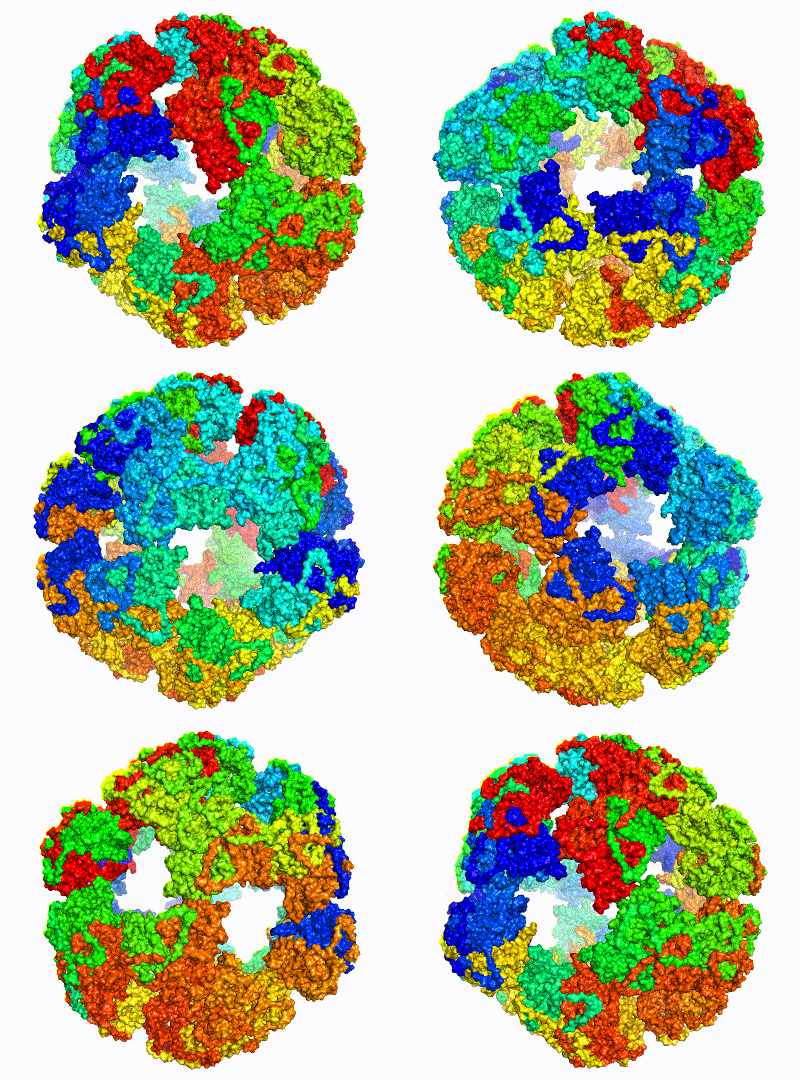
Protein cages are nanoscale particles formed by the self-assembly of protein subunits, with natural roles spanning storage (ferritin), protection (heat shock proteins), catalysis, and genetic material transfer (viruses). Through nanotechnology, they have been repurposed for vaccine scaffolds, drug delivery, imaging, and molecular electronics, making them central to nanobiotechnology.
We are developing fast forecasting tools for multivariate time series modeling and forecasting. This involve blending data compression techniques, such as autoencoders and spectral proper orthogonal decomposition, with neural networks. The former are used to identify a reduced manifold to decrease the dimension of the problem. The latter are used to forecast the system in the reduced manifold. Given the 'black-box' nature of neural-network approaches, we are developing interpretability methods, to allow for more 'white-box' forecasting workflows. Current application areas include extreme weather prediction, climate resilience and sustaninability, and healthcare.
Methods to characterize protein cages for their structures and functions using myriad techniques such as, microscopy, spectroscopy, scattering
Design of de novo protein cages or higher order structures using protein cages as the building blocks through directed evolution, rational, structure-aided, and artificial intelligence.
Ranging from repurposing to engineering, myriad applications of protein cages have been explored for health applications and beyond.
Showing 48 publications
Gopal, M., Pham, V.M., Vadanan, V.S., Dang, T.T. and Lim, S., 2025. Curcumin-loaded bacterial cellulose films suppress in vitro melanogenesis in human epidermal melanocytes. Cellulose, 32, pp.1133–1148.
Vadanan, V.S., Pasula, R.R., Joshi, N. and Lim, S., 2024. Bioengineering approach for the design of magnetic bacterial cellulose membranes. Communications Materials, 5, p.242.
Ravishankar, S., Nedumaran, A.M., Gautam, A., Ng, K.W., Czarny, B. and Lim, S., 2023. Protein nanoparticle cellular fate and responses in murine macrophages. NPG Asia Materials, 15(1), pp.1–16.
Singh, J., Steele, T.W.J. and Lim, S., 2023. Bacterial cellulose adhesive patches designed for soft mucosal interfaces. Biomaterials Advances, 144, p.213174.
Gupta, N.K., Okamoto, N., Karuppannan, S.K., Pasula, R.R., Ziyu, Z., Qi, D.C., Lim, S., Nakamura, M. and Nijhuis, C.A., 2022. The role of structural order in the mechanism of charge transport across tunnel junctions with various iron-storing proteins. Small, 18(42), p.2203338.
Gupta, N.K., Karuppannan, S.K., Pasula, R.R., Vilan, A., Martin, J., Xu, W., May, E.M., Pike, A.R., Astier, H.P.A.G., Salim, T., Lim, S. and Nijhuis, C.A., 2022. Temperature-dependent coherent tunneling across graphene–ferritin biomolecular junctions. ACS Applied Materials & Interfaces, 14(39), pp.44665–44675.
Kumar, K.S., Martin, J., Xu, W., Pasula, R.R., Lim, S. and Nijhuis, C.A., 2022. Biomolecular control over local gating in bilayer graphene induced by ferritin. iScience, 25(4), p.104128.
Vadanan, V.S. and Lim, S., 2022. Development of conductive bacterial cellulose foams using acoustic cavitation. Cellulose, 29, pp.1–14.
Vadanan, V.S., Basu, A. and Lim, S., 2022. Bacterial cellulose production, functionalization, and development of hybrid materials using synthetic biology. Polymer Journal, 54(4), pp.481–492.
Sun, R. and Lim, S., 2021. Protein cages as building blocks for superstructures. Engineering Biology.
Kumar, A., Nandwana, V., Ryoo, S.R., Ravishankar, S., Sharma, B., Pervushin, K., Dravid, V.P. and Lim, S., 2021. Magnetoferritin enhances T2 contrast in magnetic resonance imaging of macrophages. Materials Science and Engineering: C, 128, p.112282.
Kaku, T.S. and Lim, S., 2021. Protein nanoparticles in molecular, cellular, and tissue imaging. WIREs: Nanomedicine and Nanobiotechnology, p.e1714.
Bhaskar, S., Thng, S. and Lim, S., 2021. Engineered protein nanocages for targeted and enhanced dermal melanocyte cellular uptake. Advanced NanoBiomed Research, 1(7), p.2000115.
Kumar, K.S., Pasula, R.R., Lim, S. and Nijhuis, C.A., 2021. Room-temperature tunnel magnetoresistance across biomolecular tunnel junctions based on ferritin. Journal of Physics: Materials, 4(3), p.035003.
Gupta, N.K., Pasula, R.R., Karuppannan, S.K., Lim, S. and Nijhuis, C.A., 2021. Switching of the mechanism of charge transport induced by phase transitions in tunnel junctions with large biomolecular cages. Journal of Materials Chemistry C, 9, p.10768.
Lim, S. and Salentinig, S., 2021. Protein nanocage-stabilized Pickering emulsions. Current Opinion in Colloid & Interface Science, 56, p.101485.
Nasrollahi, F., Sana, B., Paramelle, D., Ahadian, S., Khademhosseini, A. and Lim, S., 2020. Incorporation of graphene quantum dots, iron, and doxorubicin in/on ferritin nanocages for bimodal imaging and drug delivery. Advanced Therapeutics, 3(4), p.1900183.
Pasula, R.R., Kuniyil, A. and Lim, S., 2020. Molecular entrapment in thermophilic ferritin for nanoformulation in photodynamic therapy. Advanced Therapeutics, 3(4), p.1900172.
Sarker, M., Lee, H., Gonçalves, R.A., Lam, Y.M., Su, H. and Lim, S., 2020. Supramolecular protein assembly retains its structural integrity at liquid–liquid interface. Advanced Materials Interfaces, 7(7), p.1901674.
Mukhopadhyay, S., Karuppannan, S.K., Pasula, R.R., Lim, S., Nijhuis, C.A., Vilan, A. and Cahen, D., 2020. Solid-state protein junctions: cross-laboratory study shows preservation of mechanism at varying electronic coupling. iScience, 23(5), p.101099.
Pham, T.T., Vadanan, V.S. and Lim, S., 2020. Enhanced rheological properties and conductivity of bacterial cellulose hydrogels and aerogels through complexation with metal ions and PEDOT/PSS. Cellulose, 27(14), pp.8075–8086.
Sana, B., Krishnan, S., Shrivastava, A., Agrawal, R., Ghosh, S. and Lim, S., 2019. Targeted delivery of doxorubicin using humic acid-modified ferritin nanocages. ACS Biomaterials Science & Engineering, 5(5), pp.2359–2367.
Sarker, M., Sana, B. and Lim, S., 2019. Protein nanocages as templates for hierarchical self-assembly. Biomacromolecules, 20(6), pp.2149–2158.
Kumar, K.S., Karuppannan, S.K., Pasula, R.R., Lim, S. and Nijhuis, C.A., 2019. Ferritin-based biomolecular tunnel junctions operating in the clean transport regime. Advanced Electronic Materials, 5(11), p.1900504.
Bhaskar, S. and Lim, S., 2018. In vitro evaluation of the cellular uptake of engineered protein nanocages. Journal of Biomedical Materials Research Part B: Applied Biomaterials, 106(2), pp.819–827.
Sana, B., Shrivastava, A. and Lim, S., 2018. Development of humic acid-ferritin hybrid nanoparticles for drug delivery applications. Bioengineering & Translational Medicine, 3(1), pp.46–54.
Sarker, M. and Lim, S., 2017. Engineered protein nanocages for hierarchical assembly. Journal of Materials Chemistry B, 5(32), pp.6433–6442.
Shrivastava, A., Sana, B. and Lim, S., 2017. Humic acid-encapsulated ferritin nanoparticles for targeted therapy. Journal of Biomedical Materials Research Part A, 105(5), pp.1432–1441.
Karuppannan, S.K., Kumar, K.S., Pasula, R.R., Lim, S. and Nijhuis, C.A., 2017. Charge transport across ferritin biomolecular junctions. Advanced Functional Materials, 27(42), p.1702446.
Sun, R., Sana, B. and Lim, S., 2016. Structural plasticity of protein cages in response to chemical modifications. Biomacromolecules, 17(6), pp.2111–2119.
Krishnan, S., Sana, B. and Lim, S., 2016. Engineered ferritin nanocages as a versatile platform for drug delivery. Journal of Controlled Release, 235, pp.122–131.
Sana, B., Sun, R. and Lim, S., 2015. Tailoring the assembly properties of protein nanocages via genetic engineering. Journal of Materials Chemistry B, 3(24), pp.4811–4818.
Bhaskar, S. and Lim, S., 2015. Evaluation of cellular interactions of functionalized protein nanocages. Journal of Biomedical Materials Research Part A, 103(4), pp.1342–1351.
Sun, R. and Lim, S., 2014. Assembling protein cages into complex macrostructural networks. Applied Nanoscience, 4(7), pp.811–819.
Sana, B. and Lim, S., 2014. Humic acid-conjugated ferritin nanoparticles for target-specific molecular imaging. Journal of Biomedical Materials Research Part A, 102(3), pp.723–731.
Bhaskar, S. and Lim, S., 2014. Engineering protein nanocages as a container system for drug delivery application. Biomaterials, 35(1), pp.444–454.
Lim, S., 2013. Fascinating molecular containers: architectures and functionalizations of protein cages. Biotechnology and Bioprocess Engineering, 18(1), pp.1–11.
Lim, S., 2012. The emergence of protein cages in bionanotechnology. Journal of Biotechnology & Biomaterial, 2(3), p.e107.
Zhao, Q., Lim, S. and Wang, S.-W., 2011. A design methodology to tune disassembly properties in a caged protein platform. Biotechnology and Bioengineering, 108(8), pp.1741–1751.
Lim, S., 2010. Functionalizing the inside of protein cages for medical applications. Biointerphases, 5(3), pp.FA48–FA52.
Dalmau, M., Lim, S. and Wang, S.-W., 2009. pH-triggered disassembly in a caged protein complex. Biomacromolecules, 10(12), pp.3199–3206.
Dalmau, M., Lim, S. and Wang, S.-W., 2009. Design of a pH-dependent molecular switch in a caged protein platform. Nano Letters, 9(1), pp.160–166.
Protein cages have been modified to carry non-natural cargoes, such as therapeutic agents, active molecules and imaging agents.. Therapeutic agents can include small‑molecule compounds,while vitamins and cosmetic actives fall within a broader class of functional molecules. Protein cages have been explored as carriers for contrast‑enhancing metals to support soft‑tissue imaging studies, and have been modified with antibodies, fragments, or aptamers to examine cell‑type–specific targeting and localized accumulation. Their formulations span liquids (e.g., injectable formats), powders (e.g., intranasal delivery), and emulsions or gels (e.g., topical or transdermal applications)
Display of multiple ligands (e.g., peptides, antibodies) to modulate the immune system. Leveraging on their amenability to modifications, protein cages have been used as a scaffold to display multiple ligands with spatial precision.
Beyond health, the applications of protein cages have been further explored that include (1) Molecular electronics: protein cages loaded with metals have been shown to have conductive properties, (2) Templating/Scaffolding: protein cages provide natural size control as a container to template the synthesis of nanomaterials; assembled protein cages forming higher-order structures have been explored to enhance multi-step catalysis.
Join the largest Protein Cage Network of researchers advancing nanomedicine, bioengineering, and molecular design through the power of protein cages.


